The Indus Valley
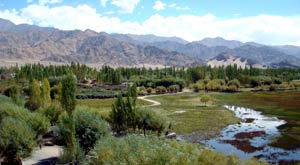
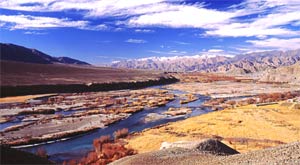
Indus, the great trans-Himalayan river, derives its conventional name from the Tibetan and Sanskrit name Sindhu.
The earliest chronicles and hymns of the Aryan peoples of ancient India, the Rigveda, composed about 1500 BCE, mention Sindhu as the source of the country’s name. Locally known as Singe Khabab or the Lion River, the Indus rises in southwestern Tibet at an elevation of about 18,000 feet / 5,500 metres. From here it flows northwest for about 200 miles / 320 km, crossing the southeastern boundary of Ladakh at an altitude of about 15,000 feet / 4,600 metres.
A short way beyond Leh, it is joined by the first major tributary, the Zaskar River. Continuing for about 150 miles (240 km) in the same direction, it enters into the Pakistani-administered region of Baltistan, enroute receiving its other notable tributary, the Shyok River on the right bank. In its course through Ladakh, the Indus carves out a narrow and winding trans-Himalayan valley system which is geographically referred to as “the Indus Furrow” and sustains majority of the region’s population.
Leh - The Capital City
The Indus Valley is the geographical backbone of Ladakh. It is home to the largest concentration of villages and people, as well as monasteries, monuments and places of historical importance. Leh, the ancient capital of the region nestles along its left bank slopes. Leh is a historic town, having been the Royal Capital of the old kingdom since the 15th century, and the caravan centre of Central Asian trade. It was the first capital of King Takspa Bum-lde who ruled over the area from 1400 to 1430 CE. He is believed to have built the ‘Red Chapel’ containing the 3-storey high statue of the Maitreya Buddha, as well as the Stupa of Ti-siru or Ti’u-Tashis Od-phro containing 108 temples, on the Tiu-Serpo hill.
| |
 |
The first recorded fort at Leh was Namgyal Tsemo Fort by King Tashi Namgyal (1500-1530) on the hill overlooking the town. Of the fort only the ruined remains are found, but the associated temples are intact, being maintained by Sankar monastery. The complex comprises the Maitreya Temple and the Gon-khang housing a large image of the 6-armed Mahakala with a protruding phallus, which is superstitiously worshipped by barren women wishing the favour of a child. Behind the fort walls, the remains of even more ancient fortifications are seen. These are locally known as Dard Castle (Dok-khar) indicating that there was a castle here even before the establishment of the ruling dynasty of Tibetan origin. On the hill below the Namgyal Tsemo is the nine-storey Leh Palace (Lhachen Palkhar) built by King Singge Namgyal in 1600 AD in the grand tradition of Tibetan architecture. It is said to have inspired the design of the famous Potala in Lhasa built about half a century later.
 |
|
For long a bustling crossroads of the migration & trade routes, Leh is by itself a sightseeing attraction. Strolling along its lanes and by-lanes, observing the crowd and looking into the curio shops is an engaging experience. From the head of the main Bazaar begins the old alleyways and piled-up houses of the old town, clustering around the foot of the Palace Hill. The head of the Bazaar is dominated by the Jamia Masjid, which was built during 1666-67 on a land grant given by King Deldan Nmagyal. The present structure has been built many times and lost the original characteristic although it is much expanded in size. Also located within the main market area is the Jo-Khang commonly known as Gompa Soma (or New Monastery), built in 1957 by the Ladakh Buddhist Association. Behind the main Bazaar, Nau Shehar has interesting little shops selling curios and jewellery. The old labyrinthine alleyway system around the foot of the Palace Hill, is now partly developed into a road system. In the other direction, down the bazaar, are the Tibetan markets where one can bargain for pearls, turquoise, coral, lapis lazuli and many other kinds of semi-precious stones and jewellery, as well as carved yak-horn boxes, quaint brass locks, china or metal bowls, or any of a whole array of curios. Moti Market is another bustling system of narrow streets & alleyways lined with hundreds of small shops & kiosks. There are many handicraft show rooms in the main market which stock local handicrafts such as handmade carpets, woolen shawls, dragon paintings, thangkas, lacquered tea-tables, etc., all ideal picking as souvenirs.
Monuments
The section of the Indus Valley from Upshi down to Khalatse, a stretch of about150 kms, is the region’s historic heartland as well. It is dotted with all the major sites connected with the former kingdom's history, starting with Leh, the royal capital since the building of the Leh Palace. Some distance upstream the Indus is Shey, Ladakh’s most ancient capital, with its palaces and temples. Downstream the Indus are the ruins of Basgo, located just above the highway, and Tingmosgang, situated a short distance up a side-valley, both served as royal capitals when the Old Kingdom was temporarily divided into two parts in the 15th century. Just across the river from Leh is Stok village which was assigned to the deposed royal family in lieu of the loss of the Leh throne to the Dogra conquerors of Ladakh. Stok Palace, where the royal family now lives, houses a museum of artifacts associated with the Namgyal dynasty.
| |
 |
Leh Palace - This is an impressive and captivating piece of architecture which lends to the town an impressive backdrop, rendering to Leh the ambience of a heritage town. It catches the attention of the tourists almost immediately due to its dramatic location on the Palace Hill, overlooking the town. It was built as the royal residence by King Singge Namgyal during the 17th century. Although much smaller in size, Leh Palace resembles the Potala in Lhasa, built over half a century later, and believed to have been inspired by the former. The Palace is built in the medieval Tibetan architectural style, featuring colossal inclined buttressed walls and protruding wooden balconies. It is nine storeys high; the upper floors accommodated the royal family, while the stables and store rooms were in the lower floors. Leh palace was the home of the royal family until they were exiled to Stok in the 1830s. The Victory Tower set above the palace was built to commemorate the victory of Ladakhi soldiers over the invading Balti army in the early 16th century. Leh Palace is currently being restored by the Archaeological Survey of India. It is open for visitors and the roof provides panoramic views of Leh and the surrounding areas.
Shey Palace - Shey palace (12 kms) is the most important citadel of Ladakh, both from historical and cultural view point. Located on a hillock above the bed of the Indus, it was the ancient capital of the kingdom. It is also believed to have been the capital of the pre-Tibetan Chiefs of Upper Ladakh, presumably the descendants of Kesar, the folk hero of the Tibetan cultural region. The ruined remains of an ancient fortification above the present palace indicate the antiquity and importance of the site. Inscriptions found at the site by A.H. Francke suggest that Shey was the capital fort of the whole kingdom which was established during the 10th century by descendants of Nima-gon, the fugitive prince from the central Tibetan ruling dynasty. It became the formal capital of the Namgyal dynasty during the 16th century.
There are several places of worship incorporated in the palace complex. These include the temple containing the gigantic copper-gilt image of a seated Sakyamuni, commissioner by King Deldan Namgyal (late 17th century). The lamps burning in front of this image include an enormous one of silver encrusted with turquoises, which is said to hold enough butter to keep it burning for a year. Within the complex there are two Tantric shrines as well as a temple of the Buddha Amitabha, the meditation Buddha.
The other place of worship is a temple called Tresthang Gonpa located outside the main palace building. It also contains a gigantic image of a seated Buddha, installed by King Singge Namgyal (mid 17th century). This image is so large that one walks around the base of the image on the ground floor and then around the shoulder and head when one ascends to the next floor. It is believed that Nepalese craftsmen were specially brought for erecting this image. These craftsmen were subsequently settled at Chilling, where their descendants continue to carry out their craft in metals. The walls surrounding the image have very fine mural paintings of the sixteen Arhats and other Buddhist personalities such as Padmasambhava, Atisa & Tsong-kha-pa. The annual festival of Shey Srubla is held in this monastery.
Stok Palace - Stok Palace (20 kms) is the present residence of the former royal family of Ladakh, after the Namgyal family was divested of their rule by the Dogra invaders during the mid 19th century. The palace was built by King Teswang Tundup Namgyal in 1825. The last king of Ladakh died here in 1974. The palace has a museum displaying the heirloom of the royal family besides religious art objects. In the queen’s chamber can be seen royal ornaments such as the beautifully crafted turquoise studded perak (head dress), the queen’s crown as well as the necklace of the Balti Princess, Gyal Khatun. In the king’s room there are exquisite thangkas on display, including a set of 35 depicting the life of Sakyamuni, which is said to date from the 16th century during the reign of Tashi Nmagyal. Other artifacts here include silver chortens, the king’s crown, a 7th century image of Avalokitesvara as well as jade cups, fine porcelain and ritual objects.
The Palace Gompa is situated behind the museum and contains some ritual dance masks and frescoes. The annual festival of “Stok Guru Tseshu” is held here during December-January. On this occasion the Oracle of Stok appears and answers questions relating to future events.
The Castle of Tingmo-gang - Tingmo-sgang lies at about 92 Kms west of the Leh. The castle of Tingmo-gang was built at the time when Gragpa Bum, younger brother of the 17th century Ladakhi king Takspa Bum-Lde was ruling over Sham area. A contemporary construction to this is the Red Chapel “Tsuglagkhang Marpo “containing a 3-storey high image of the Buddha Maitreya. It was also during this period that the self-originated image of Avalokitesvara from Assam (Kamrup) was brought & installed in the castle of Tingmosgang.
Monasteries
The same section of the Indus Valley has the greatest concentration of Buddhist monasteries or Gompas.
Out of the twelve Gompas situated on or near the Indus, the most famous is that of Alchi, called Alchi Choskor (religious conclave), famous for its ancient wall frescoes dating from the 11th and 12th centuries, which pre-date the Tibetan style of painting seen in all the other Gompas of the region.
The other major monasteries in the Indus Valley are those of Phyang, Hemis and Chemrey, all of which were founded under the direct patronage of members of the ruling Namgyal dynasty. Hemis monastery, together with that of Hanle near the Tibetan border, was established at the instance of King Singge Namgyal, while Chemrey was established by his wife after his death. Together with the Stakna monastery, dating from a slightly earlier period, all these monasteries belong to the Red Hat (Kargyu-pa) sect of Tibetan monasticism.
| |
 |
The reformist Gelugs-pa, or Yellow-Hat sect, is also well represented in central Ladakh by the monasteries of Thiksey, Likir, Ri-dzong and Spituk, and the branch monasteries of Stok, Sabu and Sankar. Ri-dzong, situated a few kilometers up a side-valley from Uley-Tokpo, was founded only a century and a half ago. Matho Gompa, nestling along the southern slopes of the Indus valley represents the smaller Saskyapa monastic sect, and is famous for its annual “Festival of the Oracles.
The Ladakh monasteries are repositories of exquisite murals, gilded statues, religious icons, carvings, scrolls etc. built up through the ages. They remain alive with the devotions of monks, young and old. Here it is possible to receive a lama's blessing, consult an astrologer about your future, hear the wail of a horn echoing from the mountain walls, and witness a lifestyle passed down intact through the ages.
 |
|
Note for visitors to monasteries - The monasteries are the fountainhead of Buddhist religion and culture of Ladakh. Visitors are advised to respect their sanctity and appreciate their heritage importance. Shoes may have to be removed before entering some of the temples, while ladies are not allowed to enter the Gon-Khang or the room dedicated to the guardian divinities. Most of the region’s major monasteries are open throughout the day and a caretaker Lama is available to show visitors around. Some of the less visited establishments have special opening hours as in the case of the Namgyal Tsemo, Shey Palace etc. Check the timings before proceeding to these places.
Other Attractions
Magnetic Hill - Magnetic Hill is a gravity hill located on the national highway at about 30 kms west of Leh. This hill is renowned for the magnetic effect which pulls vehicles uphill against natural gravity, with the engines turned off.
The spot is well marked by a prominent bill board and a white square drawn in the middle of the road. For experiencing the phenomenon of the magnetic hill the vehicle has to be placed on the marked spot in the middle of the road with the engine switched off. One can notice the vehicle moving up the inclined road at a noticeable speed. Even helicopters flying over the area are said to register this magnetic impact.
Gurudwara Patthar Sahib - Gurudwara Pathar Sahib is located near Leh, a few kilometers from the ``Magnetic. It’s believed that Guru Gobind Singh, the 10th guru of the Sikhs, had spent time meditating here during the 17th century. The Gurudwara is built around a big boulder which has features the imprint of a human back and head on it. Legend has it that during the period 1515-1518 AD, when Guru Nanak was returning to Punjab through Srinagar, after travelling to Sikkim, Nepal and Tibet, he rested at this place and meditated. A demon residing in the nearby hill was angered by his presence and threw a large rock at the Guru which hit the back of the meditating Guru and stopped there. Nothing happened to the Guru but the shape of his body got imprinted on the boulder. Seeing this, the demon felt ashamed and apologized to the Guru by prostrating at the feet.
The place remained unexplored even after the boulder was discovered during the construction of the road in the 1970’s. The road workers had tried to remove the boulder from the work site but could not do so even with bulldozers. In the meanwhile some locals were seen worshipping the impression of a human back & head on this the boulder. Upon enquiry by the army officers on the spot, it was reported that the impression was that of the Guru Rimpoche. Guru Rimpoche was taken to be referring to Guru Nanak and the Gurudwara evolved around this boulder. |